When Beaches Become Graveyards: Counting the True Cost of Australia’s Marine Heatwave
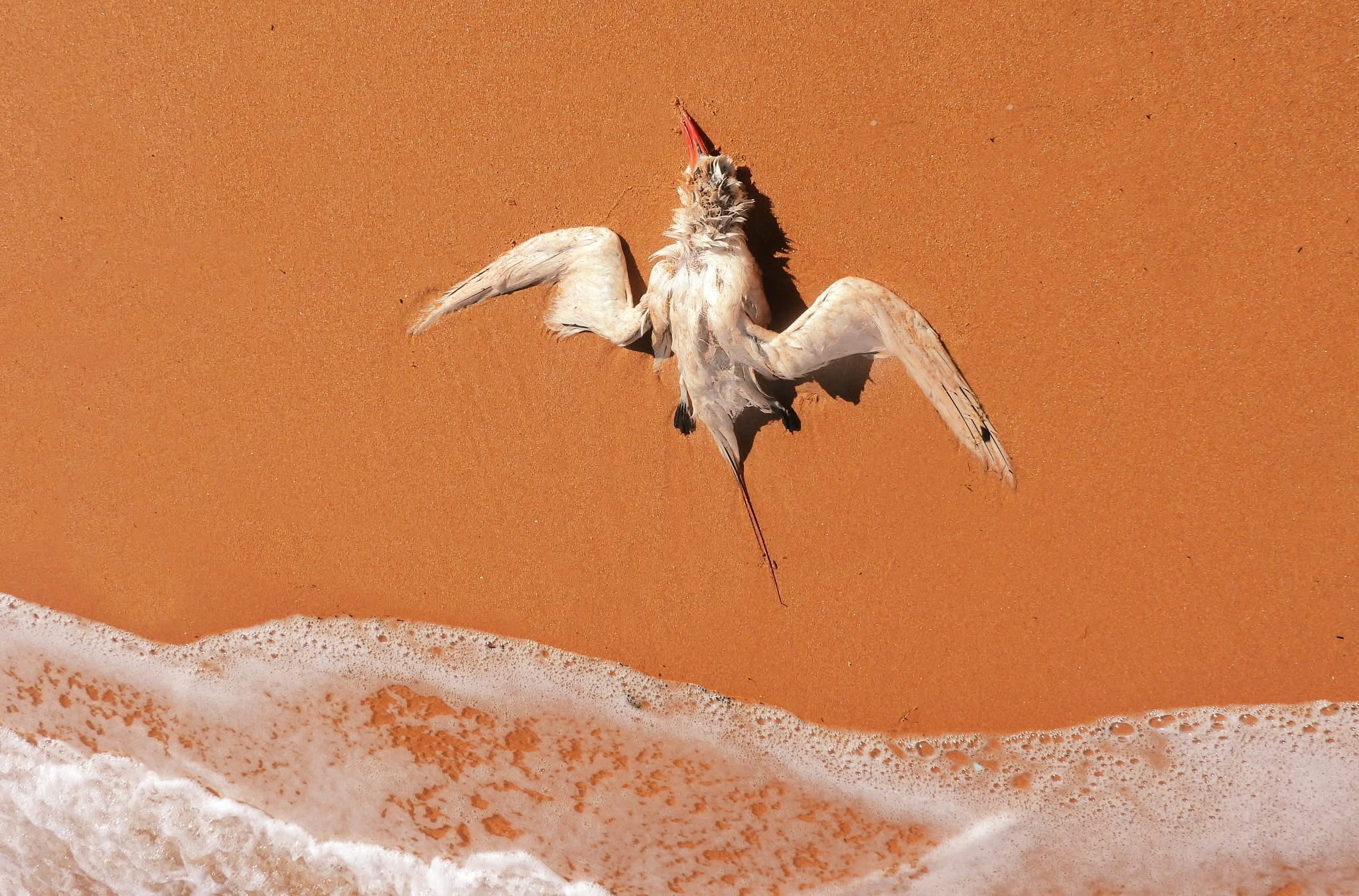
Photo credit: Robbi Luscombe-Newman, Light&Vision Photography
When thousands of seabirds wash up dead on beaches, the instinct is to count what you can see. But what washes ashore is only ever the beginning of the story. A new study from Adrift Lab researchers, just accepted in Conservation Biology, confronts that gap head-on — and the numbers it reveals are staggering.
During the 2023/2024 marine heatwave off the east coast of Australia, community scientists reported dead and dying shearwaters on beaches from Queensland to Tasmania. The images were distressing: emaciated birds scattered across the tideline. But even the most dramatic beach surveys, where observers counted hundreds of carcasses on a single stretch of sand, captured only a fraction of what was actually happening out at sea.
The problem is fundamental
When a seabird dies offshore, most of the time it simply disappears. Carcasses sink, are scavenged, or drift far out to sea before they ever near land. Research suggests that even under favourable conditions, only a fraction of birds that die within 45 kilometres of the coast will actually wash ashore. Beyond that distance, the chances of a carcass reaching a beach drop to near zero. So when thousands of shearwaters wash up on beaches, it raises an urgent question: what is actually dying out there?
Answering that question properly requires more than counting bodies on a beach. It requires understanding how efficiently searchers detect carcasses, how long those carcasses persist before being removed by scavengers or tides, what proportion of the coastline was actually searched, and critically what fraction of offshore mortality is ever likely to reach land at all. These are not simple calculations, but they are tractable ones. The analytical approaches used here were adapted from methods developed to estimate bird mortality at wind energy facilities, an unlikely but highly applicable parallel, where researchers face the same layered uncertainties around detection, persistence, and incomplete coverage.
Now for the number that stops you in your tracks.
Combining these approaches with data from the 2023/2024 heatwave, the estimated total mortality exceeded 629,000 seabirds, the vast majority of them Short-tailed Shearwaters, one of Australia’s most iconic migratory species. The birds counted directly on beaches during the event? Fewer than 5,000. That means beach surveys captured less than 1% of the birds that actually died. Every carcass on the sand represented roughly 130 more birds lost at sea, invisible and uncounted.
For the Sable Shearwater, a near-threatened species that breeds almost entirely on Lord Howe Island, the losses are particularly alarming. More than 13,000 birds are estimated to have died during the event, potentially representing around 29% of the island’s entire breeding population. A single marine heatwave. Potentially a third of a breeding colony, gone.
None of this would have been possible to quantify without an enormous contribution from community scientists across eastern Australia. In the absence of any national beached bird monitoring program, Adrift Lab reached out to the public through social media, newsletters, and a dedicated online reporting portal before the heatwave had even peaked. Hundreds of people responded by walking beaches, photographing carcasses, recording how far they’d walked and how many birds they found. Many went back within 24 hours when a follow-up photo or information was needed for species identification. Others conducted paired detection trials to help calibrate just how reliable beach surveys really are. This was not passive data collection. It was a community stepping up, rigorously, in real time.
The 2023/2024 marine heatwave was not a freak event. Australia’s east coast is one of the fastest-warming ocean regions on the planet, and marine heatwaves are projected to become more frequent, more intense, and longer-lasting. A similarly severe heatwave struck the same coastline in 2013/2014. Two catastrophic events in a single decade, for the same species, in the same waters.
Seabirds have been telling us something is badly wrong for years. The least we can do is learn to count properly and then act on what the numbers say.
Recent news posts

Subscribe for updates
Keep up to date with what we’re working on! We’ll send you emails about the lists you opt in to, and you can unsubscribe at any time.