Equality is not equity: why we have withdrawn our manuscript from Marine Environmental Research
We are withdrawing a manuscript from the journal Marine Environmental Research, and we want to explain why, publicly, because the issue is bigger than one paper.
What happened
Our manuscript, on blood chemistry in Great Frigatebirds from Oeno Atoll, was returned for revision on 3 July 2026 with a three-week deadline (24 July 2026). That window sat squarely inside the northern hemisphere summer, when fieldwork, travel, caring responsibilities, and annual leave are the norm across our team.
Dr Jennifer Lavers, our co-lead and the paper’s lead author, was overseas and unavailable until 4 August. We asked the journal for an extension to 31 August, a realistic window in which our co-authors could properly consider detailed reviewer comments and prepare a thorough revision together.
The Associate Editor, Prof. Luigi Musco, declined. His stated policy is to offer the same fixed 14-day extension to every author, regardless of circumstance, and to treat that as the fair approach. Beyond those 14 days, the only option offered was to withdraw the manuscript and resubmit later, restarting elements of the editorial process. He emphasized that this is his policy, not the publisher’s (and perhaps not even the journal’s!).
We asked him to reconsider, and set out why a flat, one-size-fits-all deadline disadvantages researchers with caring responsibilities, disabilities, medical needs, limited institutional support, heavy teaching or administrative loads, or field-based roles without reliable internet access or even those who might be on annual leave. The response we received defended the policy as consistent and, in the editor’s words, “fair”.
We disagree, and we think the distinction matters enough to talk about publicly.
Equality is not the same as equity
Equality means treating everyone the same. Equity means recognising that people start from different positions and adjusting accordingly so that everyone has a genuine chance to meet the same standard.
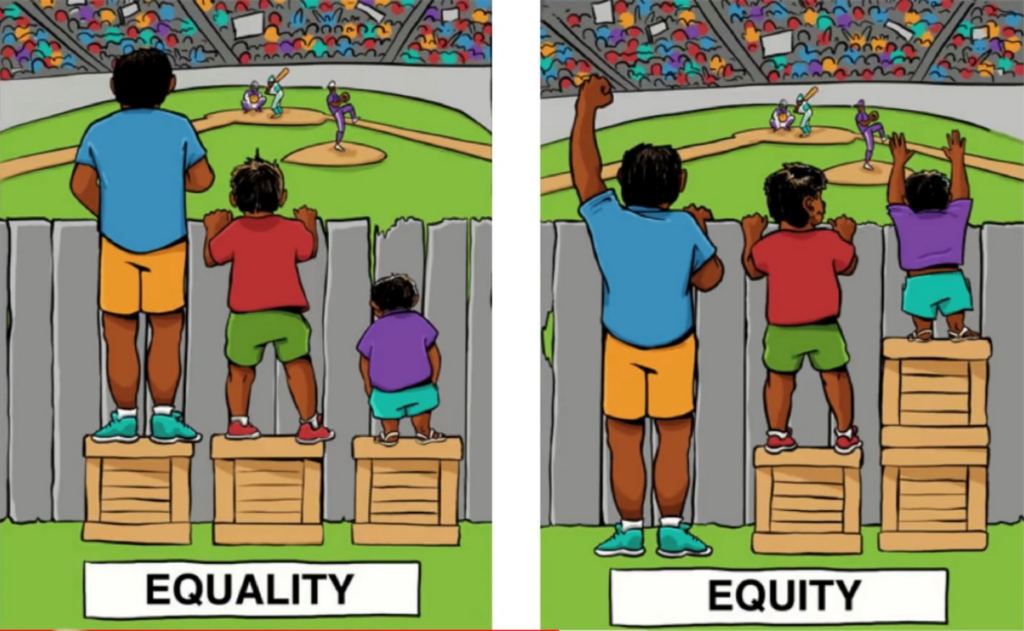
A flat 14-day extension, offered identically to every author regardless of context, is equality. It looks fair on paper. But it is not equity, because it takes no account of who can actually use that time. A researcher at their desk with full institutional support and a 14-day extension is in a completely different position to a researcher who is overseas, coordinating a multi-author response, or managing care responsibilities alongside fieldwork or commitments or annual leave booked months in advance.
Applying an identical rule to unequal starting points does not produce a fair outcome. It simply reproduces existing advantage and calls it consistency.
This is not an abstract point for us. Adrift Lab is a cooperative, community and community-supported research group working across Australia, Aotearoa New Zealand and the United Kingdom, with fieldwork in remote locations including Oeno Atoll in the Pitcairn Islands. Our co-authors are not all sitting in the same office with the same support structures and working the same pattern of hours or days of the week. A policy that assumes otherwise is not neutral. It has a differential effect, and that effect falls hardest on exactly the kind of distributed, field-based, cooperative research that produces work like this.
Why we are speaking up
We believe in going directly to people first. We raised this with the editor, explained our reasoning, and asked for a considered exception. That request was declined, on the basis that consistency required treating every case identically, irrespective of the practical realities involved.
We believe good science depends on good relations. Editorial policy is a relationship, between journals and the researchers whose work sustains them. A policy that cannot flex for genuine, explained circumstances is not protecting fairness. It is avoiding the harder, fairer conversation.
We believe this is bigger than one manuscript. Many journals now publish commitments to equity, diversity and inclusion. Indeed, Elsevier, the publisher of Marine Environmental Research, has an entire page extolling their virtues in “shaping an inclusive culture” which is “at the heart of everything [they] do”. (https://www.elsevier.com/about/inclusion). Revision timelines are a small, practical place where those commitments are tested. If a fixed extension is offered as the only accommodation, regardless of what an author actually explains about their situation, then the commitment is words rather than practice.
What we have decided
We have withdrawn our manuscript from Marine Environmental Research, and we will not be submitting this or future work to the journal. We are publishing the full email exchange below, unedited, so that others can read the exchange for themselves and reach their own conclusions. We have removed email addresses and some personal information, but they are otherwise unaltered.
We are not doing this to single out an individual editor for acting outside of his journal’s policy. We are doing it because we think the policy itself, and the reasoning offered in its defence, is worth public scrutiny. If journals want researchers to trust that equity commitments are meaningful, those commitments have to survive contact with an “inconvenient”, real world request.
We would welcome a conversation with Marine Environmental Research, or with any journal, about what a genuinely equitable revision policy could look like. Our door remains open.
The full email exchange
Published in full and in chronological order, exactly as received and sent.
From: Editorial Manager behalf of Luigi Musco
Sent: Friday, July 17, 2026 4:29 PM
To: Jennifer Lavers
Subject: Revision of “Blood chemistry of Great Frigatebirds (Fregata minor) from Oeno Atoll reveals haematological variation consistent with age-dependent development in an ocean sentinel” is due soon
*This is an automated message.*
Manuscript Number: MERE-D-26-01393
Dear Lavers,
We would like to remind you that on Jul 03, 2026 we asked you to revise your above referenced manuscript and your revision is due by Jul 24, 2026.
Marine Environmental Research values your contribution and we look forward to receiving your revised manuscript.
To submit your revision, please log in as an author at https://www.editorialmanager.com/MERE/, and navigate to the “Submissions Needing Revision” folder under the Author Main Menu. You will also find the decision letter and comments available there.
If you do not plan to revise your manuscript, please click “Decline to Revise” in the “Submissions Needing Revision” folder.
If you require more time, please contact the journal office by replying to this email.
Kind regards,
Marine Environmental Research
From: Jennifer Lavers
Sent: Saturday, 18 July 2026, 00:54
To: Editor
Cc: Alex Bond
Dear Editor
I am overseas and unavailable until 4 Aug. Can I kindly request an extension on this article until 31 Aug 2026.
Thank you
Jennifer
Alex Bond cc’d
From: Luigi MUSCO
Sent: 20 July 2026, 8:55 AM
To: Jennifer Lavers
Cc: Alex Bond
Subject: Re: Revision of “Blood chemistry of Great Frigatebirds…” is due soon
Dear Jennifer,
Thank you for your message. I hope you are enjoying your time overseas.
Unfortunately, I am not able to grant an extension as long as requested. The maximum extension I can offer is 14 additional days.
If this is not sufficient, one possible option would be to withdraw the manuscript and resubmit it once you are in a position to complete the revisions. In that case, please include in your cover letter to the Editor a brief explanation of the manuscript’s history, and provide a detailed, point-by-point response to all reviewer comments together with the revised submission.
Please let me know how you would like to proceed.
Kind regards,
Luigi
Prof. Luigi Musco
Associate Professor of Zoology
University of Salento, Department of Biological and Environmental Sciences and Technologies (DiSTeBA)
Associate Editor of Marine Environmental Research
From: Alex Bond
Sent: 20 July 2026, 17:49
To: Prof. Luigi Musco
Cc: Jennifer Lavers
Dear Prof. Musco,
Thank you for your reply.
I must admit I am disappointed by the inflexibility of the journal’s position on revision deadlines. The manuscript was only returned to us on 3 July with a three-week turnaround, a period that falls squarely within the northern hemisphere summer holiday season when many researchers are committed to fieldwork, travel, caring responsibilities, annual leave, or institutional closures.
While I appreciate your offer of a 14-day extension, I do not believe this adequately addresses the practical realities of contemporary research or supports the journal’s stated commitment to fairness and inclusion. Policies that assume all authors can respond to detailed reviewer comments within a few weeks disproportionately disadvantage researchers with caring responsibilities, disabilities, medical needs, limited institutional support, significant teaching or administrative commitments, or work in part-time or field-based roles that require extended periods away from reliable internet access.
More broadly, such policies create barriers to participation that run counter to the principles of equity, diversity and inclusion that many journals and publishers now publicly endorse. An approach that requires authors either to complete revisions within a narrow timeframe or withdraw and resubmit their work places an unnecessary administrative burden on both authors and editors while doing little to improve the quality or speed of the scientific process.
In this particular case, the corresponding author is currently overseas and unavailable until 4 August. The requested extension to 31 August was therefore intended to provide a realistic period in which the co-authors can carefully consider the reviewers’ comments and prepare a thorough revision. Producing a high-quality response inevitably requires coordination between multiple researchers, each with existing professional commitments. Scientific revision is not a full-time activity that can simply be prioritised above all other responsibilities for a period of weeks.
I would therefore respectfully ask that the journal reconsider its position and grant the requested extension to 31 August 2026. Doing so would allow us to submit the strongest possible revision without creating unnecessary pressure on the author team or forcing withdrawal and resubmission of a manuscript that remains actively under revision.
I would also encourage the journal to reflect on whether its current revision timelines are genuinely compatible with the realities of modern academic practice and with broader commitments to accessibility and inclusive participation in research.
I look forward to your response.
Kind regards,
Alex Bond
On behalf of the authors
From: Prof. Luigi Musco
To: Alex Bond
Cc: Jennifer Lavers
Dear Dr Bond,
Thank you for your thoughtful email and for explaining the circumstances surrounding your revision.
I fully appreciate that coordinating a revision involving multiple co-authors during the summer period can be challenging, and I understand the broader concerns you raise regarding revision timelines.
My approach, however, is to apply the same policy consistently to all manuscripts. For every submission, I am happy to grant an extension of up to 14 days beyond the original deadline; the choice to allow those additional 14 days is mine and not imposed, effectively doubling the time available for revision. Beyond this, I do not make further exceptions, as I believe that applying the same limit to all authors is the fairest approach.
I would also like to clarify that withdrawing the manuscript after the revision deadline should not be regarded as a rejection or a negative editorial decision. Rather, it is the mechanism that provides the flexibility you are seeking. Once the authors are in a position to prepare the revision, the manuscript can be resubmitted together with the previous review history. In such cases, I normally invite the same reviewers to assess the revised version, allowing the editorial process to continue from where it left off rather than starting again from the beginning.
I appreciate that this may not be your preferred solution, but it ensures that all authors are treated consistently while also allowing those who require additional time to revise their work without prejudice to its scientific evaluation.
I look forward to receiving either your revised manuscript within the extended deadline (August 7) or, if more time is required, a resubmission when the author team is ready.
Kind regards,
Luigi Musco
Prof. Luigi Musco
Associate Professor of Zoology
University of Salento, Department of Biological and Environmental Sciences and Technologies (DiSTeBA)
Associate Editor of Marine Environmental Research
From: Jennifer Lavers
To: Prof. Luigi Musco / Marine Environmental Research
Cc: Alex Bond, Elsevier Author Feedback
Dear Luigi
Your response is unacceptable; it demonstrates a clear lack of understanding of equality vs equity. Alex and I will be making a public statement regarding this interaction, which will include making this email thread publicly available. If positive change cannot be brought about by individual dialogue, then public discourse is required.
We withdraw our manuscript, and will not be resubmitting it (or future articles) to MER.
Jennifer
Cc’d Elsevier author feedback
Recent news posts




Subscribe for updates
Keep up to date with what we’re working on! We’ll send you emails about the lists you opt in to, and you can unsubscribe at any time.